Monday, February 9, 2009

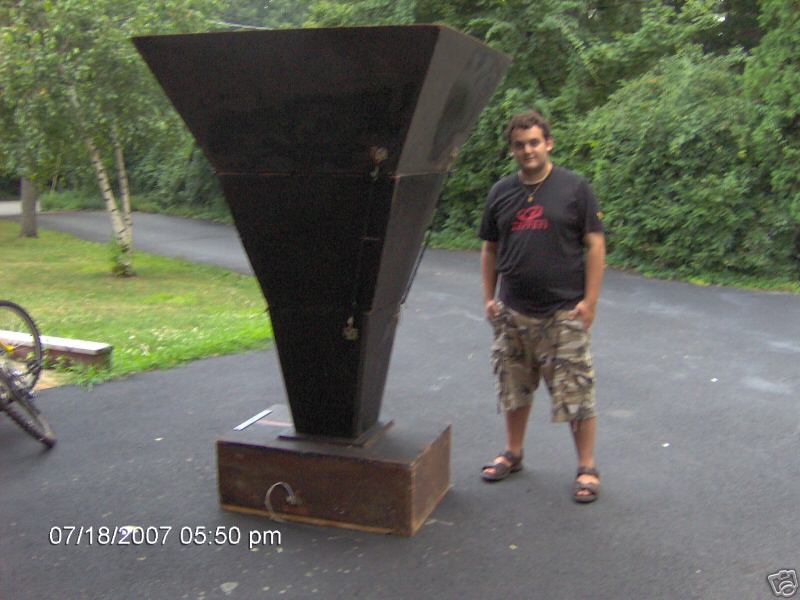
Big Bertha


Here's a fun horn. GRIN!


Precise details are unknown to me. More pics here.


Note that this thread is in Romy the Cat's domain and he's a... free thinker. There is lots of interesting hornstuff to read there, but keep in mind he is the only one that understands his own line of thought and agrees with it. He may be a genious, he may be a bit... free.

Monday, January 19, 2009

Visitors

Just a quick note, this blog has passed 20,000 visits and 60,000 page views. Thanks everybody.

Friday, January 16, 2009

RT horns, Klason horns

I've been sitting on some stuff about the RT horns, otherwise known as Klason. I was holding back because I've been on about vintage so much already and thought I'd do some new development instead.

In the meantime, a poster over at diyaudio has built one of the later models and is trying to come to grips with it. You can find his thread here.

I just LOVE the Klason/RT horns. Very convenient, very well conceived.

Tuesday, January 13, 2009

Determining range and crossover

Nice to get some responses to my last post. I notice some heads go up when there is new horn matter created!

I have been playing with the crossover function of Foobar (it's a third party plugin) to investigate how much range I would like and what a 100 Hz crossover sounds like. I have added a screenshot, because it shows sooo much.

What you are looking at, is a two-way setup, crossed at 100 Hz at 24 dB/octave. The top two tracks of the oscilloscope are below 100 Hz, the two lower tracks are above 100Hz. This is with reggae music (bass heavy). Visually, it already indicates the difference in frequency and amplitude. The difference in amplitude is less pronounced with acoustic classical/orchestral music, but the overall impression remains. This is why basshorns must be large.

Next, I kept lowering the crossover point, to where I wasn't hearing much. Although reggae and other music with electric bass guitar isn't supposed to go below around 40 Hz (38 Hz, or 38.8 Hz or whatever according to whoever you are speaking to), I was suprised to learn that I still have all kinds of musical sensations even when crossed around 35 Hz. Even at extremely steep crossover slopes. I could follow the bass lines, both rhythmically as pitch-wise. Reggae is extreme in this area, with strongly accentuated low bass, and I listen to a lot of reggae. It seems it makes sense going for quite a low cut off.

I think I will aim for around 30 Hz lower extension, or lower. I'll compile a shortlist of ready designs next time, or maybe come up with some new design sketches.

Sunday, December 28, 2008

Development Project

There are many things to consider when working on your dream loudspeaker system. Physics, technology, the cool factor. Another one is living around the thing. In my case, after moving to a new house, the system is proving too large to be practical. I am using LaScala bass horns (filtered to have flat response to 40 Hz) and horns with fullrange drivers for midrange and (some) treble. Due to the layout of the room, we have to sit pretty close and the integration between bass and the rest is hard. It also looks imposing and my girlfriend and I keep bumping into the things.

I have come to the conclusion that it's better to change my approach and my system. I'm looking towards cutting edge and vintage answers to this problem. Some of the legendary hornsystems were cornerhorns and some of the arguments for using corners were that they provide opportunities for excellent bass response and are convenient use of space. (See Klipsch for reasoning.) In my personal case, I only have one corner available and I am not about to go mono. Luckily, there's plenty of material that suggests that at a cutoff of 100Hz or below, it's impossible or at least very hard to locate a sound source, so going with something other than stereo below 100 Hz is OK.

Based on this, I have decided to take a new approach to my system. I will build a horn, to be placed in a corner, for frequencies below 100Hz and will have to stretch the mid/high sections' response down to that point. Exactly how, I don't know yet.

Now, a horn in a corner is still a wide concept. I can go for a frontloaded cornerhorn (Klipschorn, Jubilee, Hartsfield), a rearloaded cornerhorn (Jensen, Tannoy, Schmacks), I can stuff a tapped horn in a corner, I can design a frontloaded, rearloaded or tapped horn myself for in a corner. The DIY (do-it-yourself) and DIY (design-it-yourself) options sound good, so I hereby announce my horn design project.

I will have to work out parameters to work with. I need to decide on desired cutoff and acceptable size. We may simply end up with the conventional tapped horn coffin, but we might end up with something very different. Of course I have ideas cooking. One hint: think Olson...
Thursday, November 20, 2008

Thread on Klipschorn center channel

By coincidence, the Klipsch approach to a fill-in center channel has led to a sub-thread on Audio Asylum. I seems my memory was all wrong, there is no subtraction of the two channels to produce a center channel, the two are simply added and reduced in level.

I think I mixed up the Klipsch center channel with a Dolby Pro-Logic decoder matrix...

Saturday, November 15, 2008

Chance find, vented frontloaded horn

I was looking for something completely different, but came across this article of the German loudspeaker DIY magazine Klang&Ton. It showcases four horndesigns, including some measurements and the construction plans. I was particularly interested by the page shown here, mainly because of the unusual and pleasing shape of the design. When I dug in deeper, I found that the basshorn is quite short, basically LaScala-like and the rest of the bass cabinet is a vented rear chamber. Very similar to what I showed earlier, in a very different form. Cool!

Scans of the full article are in this thread.