A long time ago, I posted plans and a sim of this horn, you can find that post here. I also made a sketchup model from it, which you can find here.
I was enthusiastic about it and said it was subjectively good. I had no way to measure response at the time. Unfortunately.
There is a new horn guy in town, though, and he's called DrBoar. You can find his blog here. He's an experimenter ( in fact he's a professional scientist) and builds and measures, apparently, out of curiosity.
He has made an elaborate build report on his blog (here, here and here), about this great horn. He tried a lot of drivers and presents many measurements. Good reading. In short, it is a good horn, with good response, and it's easy to build/implement.
And now, it is also objectively good. ;-)
Monday, February 4, 2013

Saturday, September 15, 2012
Wednesday, February 1, 2012
Updated Spawn
Some really good news from over at DIYAudio: Spawn Olson/Nagaoka Horns the Next Generation
These are modern backloaded horns, designed with modern simulation tools and applying best-practice of decades of horn design. They were existing designs, but are adjusted to suit more recent Fostex fullrange drivers. The care invested in these horns is admirable and the updating shows a commitment to quality beyond the first act of creation. There are several build reports online (for instance here) and reviews of soundquality these designs are very good. It is good to see these designs available freely (for non-commercial use only, contact the designers first before any commercial activities).
These are modern backloaded horns, designed with modern simulation tools and applying best-practice of decades of horn design. They were existing designs, but are adjusted to suit more recent Fostex fullrange drivers. The care invested in these horns is admirable and the updating shows a commitment to quality beyond the first act of creation. There are several build reports online (for instance here) and reviews of soundquality these designs are very good. It is good to see these designs available freely (for non-commercial use only, contact the designers first before any commercial activities).
Tuesday, December 27, 2011
Friendly take-over
Is anyone interested in taking over this blog? I find I have very little time to work on it. It's not that the interest is gone, there are simply many things asking attention. If anyone would like to take over and post on a more regular basis, I will hand it over. No further demands, just an interest in the subject matter and the intention to post something.
I will post something anyway if I find the time and inspiration.
I have been enjoying the Olson inspired Woden designs. I have always had an itch for a modified Klipschorn that would be far-far-far easier to assemble. Olson-style folding seemed the way to go, but a sensible internal lay-out was still a mystery. Look towards the Woden Maeshowe design for the direction my mind is taking. If someone feels like sketching, feel free.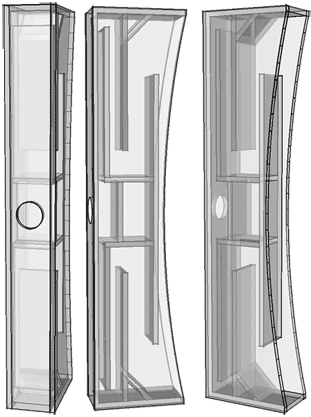
I will post something anyway if I find the time and inspiration.
I have been enjoying the Olson inspired Woden designs. I have always had an itch for a modified Klipschorn that would be far-far-far easier to assemble. Olson-style folding seemed the way to go, but a sensible internal lay-out was still a mystery. Look towards the Woden Maeshowe design for the direction my mind is taking. If someone feels like sketching, feel free.
Thursday, June 2, 2011
Electrovoice domestic horns - the Klipsch relation
I see the list of Klipsch Heritage plans is often used. I figured I'd post related Electrovoice designs.
Georgian
The Georgian is it, the direct link between Klipsch and Electrovoice. The Georgian is a Klipschorn with a different badge on it. There are constructional differences to be found in images and the plans, but I think they are not that big. The plans are also hard to find.
The Georgian is it, the direct link between Klipsch and Electrovoice. The Georgian is a Klipschorn with a different badge on it. There are constructional differences to be found in images and the plans, but I think they are not that big. The plans are also hard to find.
Patrician
A scaled up Georgian, made for an 18" driver, or is it? The brochure says it was separately designed, by someone other than PWK. In any case, it uses the folding geometry of a Klipschorn/Georgian and takes an 18". There was also a version for a 30" driver. To add to the confusion, there has also been a Patrician with a direct radiator low-end. Naturally, we focus on the horns! Highly revered and coveted, but obviously hard to get into a home ("Not in my living room!"). The plans linked to here are for 18" drivers, which seem to be better liked than the 30" driver version. The "smaller" drivers are also more readily available. Plans here, here, here, here, here and here.
Centurion
Marketed as a small Georgian, it is a hornspeaker with, clearly, a different lay-out and construction and slightly less extension. Interesting for DIY/modding, due to ease of construction. If a Klipschorn seems daunting to start with, this might be your first cornerhorn? Plans here.
Regency
Because it's a corner horn and the initial hornpath runs underneath and around the compression chamber, it looks a lot like a Klipsch design. People therefore suspect PWK had a hand in this horn himself. It's a backloaded horn with a large compression chamber, kind of Jensen Imperial-like. Plans here.

Aristocrat
The Aristocrat is either a backloaded cornerhorn or a cornerloaded bass reflex with a flared/horn port. Again, it has features of the Klipschorn and, again, it is thought PWK might have had a hand in this design. I think it looks a lot like the bottom half of a rearloaded Klipschorn. Plans here.
Baronet
This design is a lot smaller, but overall it's pretty much the same as the Aristocrat. Plans here.
Marquis
A bass reflex with a flared "horn" port. Perhaps beyond what I want to discuss here, although I might get back to horn reflex plans with the beautiful Gately corner enclosure. Plans for the Marquis are here.
Sunday, November 7, 2010
A quick word
Wow... I was distracted by life and was uninspired to post. I am getting that horn itch again, so checked back here. I found a number of comments to publish and I see from statistics that this blog is still visited regularly. I wasn't expecting that. It was inspiring, thanks.
So now I gotta think up some content...
So now I gotta think up some content...
Wednesday, November 25, 2009
Edgar and Danley: Where the military get their toys.

Years ago, I saw this picture on AudioAsylym, at the High Efficiency section. What/who you see here, is Dr. Bruce Edgar looking happy with the modular subwoofer he has built for the military. I saved the picture, but am not so sure about specific details of the desgn. As I recall, it is several of his refridgerator-sized Seismic-subs together, each extended to give greater mouth area. The military wanted something to "make big booms" and I suspect this is for training situations, exposing the soldiers to near-realistic soundlevels.
Later on, we get this film, about the Matterhorn "device" by Tom Danley. Enjoy.
Subscribe to:
Posts (Atom)